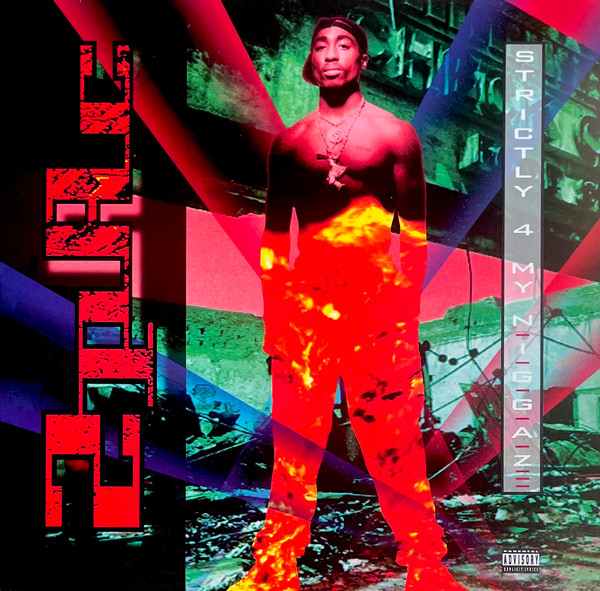
Tupac Shakur’s sophomore album Strictly 4 My N.I.G.G.A.Z… arrived in February 1993 as a dramatic evolution from his 1991 debut 2Pacalypse Now. Where that first effort established him as a socially conscious voice documenting police brutality and systemic oppression, this follow-up expanded his palette considerably, balancing righteous anger with introspection, street narratives with uplifting anthems, and raw aggression with genuine vulnerability. The album title itself, an acronym standing for Never Ignorant About Getting Goals Accomplished, signaled Shakur’s intention to reclaim and redefine language while delivering messages of empowerment to his core audience.
The production on Strictly 4 My N.I.G.G.A.Z… marked a significant sonic upgrade from the debut, with contributions from an expanded roster of producers including Stretch, Bobby Crawford, and others who helped craft a more polished, radio-friendly sound without sacrificing street credibility. The album oscillates between hard-hitting West Coast funk, sample-heavy golden era boom-bap, and surprisingly melodic compositions that showcased Shakur’s growing versatility. Tracks built around live instrumentation and soul samples gave the project a warmth that contrasted effectively with its more confrontational moments, creating a dynamic listening experience that reflected the complexity of urban life in early 1990s America.
Thematically, the album operates on multiple levels simultaneously. Shakur addresses systemic racism, economic inequality, and the struggles of single mothers with the same conviction he brings to tales of street warfare and personal vendettas. His writing demonstrates remarkable maturity for a twenty-one-year-old artist, drawing connections between individual circumstances and broader social structures. The album’s most commercially successful moments came from tracks that offered hope and resilience rather than despair, suggesting that audiences were hungry for hip-hop that acknowledged struggle while pointing toward transcendence. This duality would become a defining characteristic of Shakur’s artistic identity.
The album’s commercial performance significantly exceeded that of its predecessor, eventually achieving platinum certification and establishing Shakur as a mainstream force rather than merely an underground or cult favorite. Two singles in particular achieved substantial crossover success, receiving heavy rotation on both urban and pop radio formats. This breakthrough came at a crucial moment in hip-hop’s evolution, as the genre was transitioning from its golden era into the commercial dominance it would achieve by mid-decade. Shakur’s ability to maintain artistic credibility while achieving pop success became a template for subsequent artists navigating similar terrain.
Strictly 4 My N.I.G.G.A.Z… also captured Shakur at a pivotal moment in his personal life, released during a period when his legal troubles were escalating and his public profile was growing increasingly controversial. The album reflects an artist caught between multiple identities: the revolutionary’s son raised in the Black Panther tradition, the accomplished actor with Hollywood ambitions, the street-affiliated rapper building credibility, and the thoughtful poet concerned with social justice. These contradictions, rather than weakening the work, gave it an authenticity and depth that resonated with listeners navigating their own complex realities.
The album’s legacy extends beyond its commercial achievements to its influence on subsequent generations of socially conscious rap. Shakur demonstrated that politically engaged hip-hop need not be sonically austere or commercially unmarketable, and that vulnerability and emotional honesty could coexist with traditional markers of masculine toughness. The project laid essential groundwork for his later, even more successful releases while establishing creative patterns and thematic concerns that would define his too-brief career. In the broader context of 1990s hip-hop, Strictly 4 My N.I.G.G.A.Z… represents a crucial bridge between the message-driven rap of the late 1980s and the more commercially oriented sounds that would dominate the genre’s second half of the decade, proving that the two approaches were never as incompatible as critics sometimes suggested.
TRACK BY TRACK
1. Holler If Ya Hear Me
The album’s lead single and opening salvo built around a sample from The Whatnauts, establishing an aggressive, defiant tone with production from Pete Rock.
2. Pac’s Theme (Interlude)
A brief instrumental interlude featuring jazz-influenced production that provides a moment of reflection before the album’s intensity escalates.
3. Point The Finga
A confrontational track addressing both street rivals and systemic oppressors, produced by Tupac himself alongside QD3, showcasing his developing production skills.
4. Something 2 Die 4 (Interlude)
A spoken-word piece reflecting on values, purpose, and what truly matters in life, demonstrating Shakur’s poetic sensibilities beyond conventional rap structures.
5. Last Wordz
Featuring Ice Cube and Ice-T, this posse cut united three of rap’s most politically outspoken voices addressing police violence and systemic injustice.
6. Souljah’s Revenge
A track examining the psychological impact of violence and poverty, with production that mirrors the internal turmoil described in Shakur’s verses.
7. Peep Game
Addressing issues of exploitation and deception in both the music industry and street life, offering cautionary wisdom to listeners.
8. Strugglin’
Built around a soulful sample, this track documents economic hardship and survival strategies in impoverished communities with empathy and detail.
9. Guess Who’s Back
Produced by Shock G of Digital Underground, reuniting Shakur with his earliest mentor and collaborator for a celebration of his rising profile.
10. Representin’ 93
A time-stamped declaration of artistic presence and cultural relevance, capturing the specific moment of early 1990s West Coast hip-hop evolution.
11. Keep Ya Head Up
The album’s most commercially successful single, dedicated to Black women and addressing sexism, single parenthood, and resilience over a sample from Zapp’s “Be Alright.”
12. Strictly 4 My N.I.G.G.A.Z…
The title track serves as a mission statement, explaining the album’s acronym and Shakur’s philosophy of empowerment through redefinition and goal achievement.
13. The Streetz R Deathrow
A grim portrait of urban violence and mortality that presciently echoed the name of the label Shakur would later controversially join.
14. I Get Around
Produced by Shock G and featuring Digital Underground, this party anthem built around Zapp samples became the album’s second major crossover hit.
15. Papa’z Song
A deeply personal examination of father absence and its psychological ramifications, showcasing Shakur’s willingness to explore emotional vulnerability publicly.
16. 5 Deadly Venomz
The closing posse cut featuring Live Squad members addresses various forms of social poison afflicting urban communities through extended metaphor.
VAULT CURIOSITIES
- The album’s cover photograph, shot by Danny Clinch, featured Shakur shirtless displaying his “Thug Life” tattoo for the first time on an album cover, establishing an image that would become iconic in hip-hop visual culture. The stark black-and-white aesthetic contrasted sharply with the colorful, Afrocentric imagery that had characterized his debut, signaling a shift in presentation and persona.
- Keep Ya Head Up, despite becoming one of Shakur’s most beloved songs, was nearly left off the album due to concerns that its message and melodic approach didn’t fit with the harder-edged material. The track’s eventual inclusion and subsequent success as a single demonstrated the commercial viability of socially conscious, women-focused content in mainstream hip-hop, influencing countless artists who followed.
- The album was recorded during a tumultuous period that included Shakur’s arrest in Oakland for allegedly assaulting a fellow rapper with a baseball bat, and his involvement in a shooting incident with off-duty police officers in Atlanta. These legal troubles provided real-world context for the album’s themes of police conflict and street violence, blurring the line between artistic expression and autobiography in ways that would define media coverage of Shakur throughout his career.
- Strictly 4 My N.I.G.G.A.Z… marked the beginning of Shakur’s professional relationship with Suge Knight and Death Row Records personnel, though he was still contracted to Interscope at the time. Several Death Row-affiliated artists and producers contributed to the project, foreshadowing the controversial move that would occur after Shakur’s imprisonment in 1995, when Knight posted bail in exchange for the rapper’s signature to a three-album deal.
Leave a Reply